
In the Footsteps of St. Louis Marie de Montfort

"Footsteps Online"
Easter/Pentecost 1996 (Volume 1, Issue 2)
A Synthesis of Montfortian Spirituality - Part One
ST LOUIS MARIE DE MONTFORT is probably best-known for his devotion to our Blessed Lady. However, his particular spirituality is founded on the mystery of the Incarnation of Jesus Christ, and is truly Christocentric, i.e. centred on Christ himself. It is a mistake to see it as a purely "Marian" spirituality. What follows is an attempt at a synthesis. For a fuller presentation, see the article "Montfort Spirituality" in Jesus Living in Mary - A Handbook of the Spirituality of St Louis Marie de Montfort.
The following abbreviations are used in the text:
- LEW
- The Love of Eternal Wisdom
- TD
- Treatise on True Devotion to the Blessed Virgin
- SM
- The Secret of Mary
- H
- Hymns of St Louis Marie de Montfort
The motto of St Louis Marie de Montfort, which is repeated over 150 times in his writings, was "God Alone". This indicates that, for him, God is the absolute value; he alone is the one who gives meaning to all that exists. But it also indicates that He alone suffices: "God alone, and that suffices" (H 28:23). Therefore everything else that he will say about salvation history or our own personal life must be placed in the context of this absoluteness of God. And in fact, when St Louis Marie speaks of the place of human beings in creation, he begins with God and with his plan which he interprets as love. We can discern in the thought of St Louis Marie both a descending movement and an ascending movement.
A Descending movement
For St Louis Marie, everything begins with the Father, who wishes only to share his love with his creation, and who creates humankind to be a perfect image of his own beauty and perfection: "his supreme masterpiece, the living image of his beauty and his perfection, the great vessel of his graces, the wonderful treasury of his wealth and in a unique way his representative on earth" (LEW 35). In this he is simply in line with the Biblical interpretation and with many other great spiritual writers. But what distinguishes him from other writers is the use he makes, in speaking of this love of God and of his desire for humankind, of the "Wisdom literature" of the Old Testament, especially the Book of Wisdom and the Book of Proverbs. Here Wisdom is seen as a person who proclaims: "I was with God and I disposed everything with such perfect precision and such pleasing variety that it was like playing a game to entertain my Father and myself" (Prov. 8:30-31) (quoted in LEW 32). The Christian tradition has identified this person of Wisdom with Jesus Christ, the second person of the Holy Trinity, the Son. And St Louis Marie has made this title of Jesus Christ, the Eternal and Incarnate Wisdom of God, his favourite one. For this Wisdom of God is the one whom the Scriptures portray as loving human beings with an immense love, and desiring their love in return. "This eternal beauty, ever supremely loving, is so intent on winning man's friendship that for this very purpose he has written a book (the Book of Wisdom) in which he describes his own excellence and his desire for man's friendship. This book reads like a letter written by a lover to win the affections of his loved one, for in it he expresses such ardent desires for the heart of man, such tender longings for man's friendship, such loving invitations and promises, that you would say he could not possibly be the sovereign Lord of heaven and earth and at the same time need the friendship of man to be happy" (LEW 65).
But St Louis Marie recognises also that, despite being created to be "the living image of (God's) beauty", human beings have allowed sin to enter the equation: "But, alas, the vessel of the Godhead was shattered into a thousand pieces" (LEW 39). God, however, in his continuing love, proposes to rescue them from the state in which they then find themselves: "I seem to see this lovable Sovereign convoking and assembling the most holy Trinity, a second time, so to speak, for the purpose of rehabilitating man in the state he formerly created him" (LEW 42); and it is Eternal Wisdom who offers himself to bring this about: "Wonder of wonders! With boundless and incomprehensible love, this tender-hearted Lord offers to comply with his justice, to calm the divine anger, to rescue us from the slavery of the devil and from the flames of hell, and to merit for us eternal happiness" (LEW 45). So the Incarnation is decreed, and "Eternal Wisdom" becomes "Wisdom Eternal and Incarnate". The Incarnation is, for St Louis Marie, as for most of the members of the so-called French School of Spirituality, the core mystery of the loving plan of salvation devised by God. In this mystery is revealed that love of God for human beings, but also the way in which they may receive the fruits of this plan.
The Incarnation, for St Louis Marie, is not just an event (the Son of God becoming human flesh and blood), but a new reality for humankind and indeed for all creation, and a state which encloses all that Jesus Christ did and achieved as man/God. It encompasses the "Paschal mystery" - the death and resurrection of Christ which seals our salvation. He sees the whole life of Christ as the manifestation of his love and the working out of the plan of God. But, in the midst of this whole, he sees the sacrificial death of Christ (the Cross) as "the greatest secret of the King - the greatest mystery of Eternal Wisdom" (LEW 167): "Among all the motives impelling us to love Jesus Christ, the Wisdom incarnate, the strongest, in my opinion, is the sufferings he chose to endure to prove his love for us" (LEW 154). The Cross is not so much the punishment of God wreaked upon Christ in our place, as the final proof of his love for us. And this love is the victory. Although St Louis Marie has little to say of the Resurrection of Christ, for him the Cross is the triumph of love over sin and hatred, of life over death.
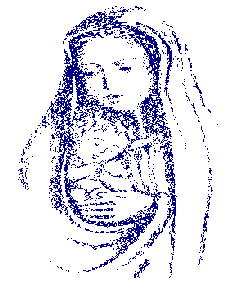 In the mystery of the Incarnation, St Louis Marie sees also the place of Mary. Although he was absolutely free to choose any means he wished to accomplish his plan of salvation ("this great Lord, who is ever independent and self-sufficient, never had and does not now have any absolute need of the Blessed Virgin for the accomplishment of his will and the manifestation of his glory" (TD 14)), God chose to use the free consent of Mary, and her docility to the Holy Spirit, to bring about the Incarnation and therefore the salvation of humankind: "God has decided to begin and accomplish his greatest works through the Blessed Virgin" (TD 15). In giving this free consent, she was, as it were, the representative of human beings of all ages, who in her also gave consent. She was thus constituted a "type" of the Church, the assemblage of all those who would enter into the mystery of salvation. St Louis Marie will develop this theme much further in speaking of how this salvation is to be applied to human beings.
This descending movement of God's love, manifested in the Incarnation of Eternal Wisdom for the salvation of human beings, through the co-operation of the Blessed Virgin, and brought to completion in the triumph of the Cross of Christ, is a call from God to us to receive and welcome his loving plan. But it requires our freely-given response.
(To be continued in next issue).
