
In the Footsteps of St. Louis Marie de Montfort

"Footsteps Online"
Easter/Pentecost 1999 (Volume 4, Issue 2)
The Cross and the Empty Tomb
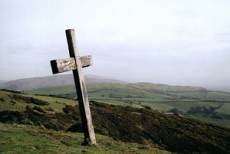 On Good Friday last year, I stood beside a wooden cross on a hillside in North Wales. The cross had been placed there originally, I believe, by a BBC production team who were making a documentary on the life of Gerard Manley Hopkins, who had spent a part of his life at St. Beuno’s, then the Jesuit scholasticate, further down this same hillside. Over to the right I could see the A55 main road from Chester to Bangor, running along the coast. It was filled with traffic, mostly cars, carrying people to the various seaside resorts along the North Wales coast. Seen from this hillside, they seemed to me like lemmings rushing towards the sea, and I asked myself, "Where are they all going?"
Yes, of course, they were going to Rhyll, Llandudno, Penmaenmawr, or Bangor. That’s where they were going that day. To enjoy the holiday. To relax. To have fun. But where were they going in life? I wondered whether many of them gave a thought to the fact that it was "Good" Friday, or why we call it "Good". It is true that many churches in our country welcome one of their biggest congregations on Good Friday, but still there are millions perhaps for whom this day means nothing more than the beginning of the longest holiday weekend in the calendar. I doubt if they see any connection even between the word "holiday" and "holy day". The aim of most of those people rushing along the road below was to enjoy what they could of the pleasures of this life. The contrast with the cross beside which I stood was stark for me at that moment.
St. Louis Marie de Montfort, in his book "The Love of Eternal Wisdom", contrasts the wisdom of this world with the wisdom of God. The wisdom of the world, he tells us, takes many forms, but in general is concerned with the search for honour, for wealth, for pleasure or for power. The wisdom of God, on the other hand, is manifested most clearly in the Cross of Jesus Christ. He even says: "Wisdom is the Cross, and the Cross is Wisdom". Our human nature almost instinctively recoils from the suffering symbolised by the Cross. We certainly do not easily welcome hardship in our own lives, and we are all tempted to seek the easiest way, the most comfortable life-style. Yet, St. Louis Marie assures us (as does the whole Christian Gospel) that the only true wisdom is the wisdom of God, the Wisdom of the Cross - personified in Jesus Christ, the "eternal and incarnate Wisdom" who died for us on the Cross. It is the only wisdom which leads to the new life of the Resurrection. The only wisdom that makes the empty tomb a symbol of fullness rather than of an empty life.
In this issue of "FOOTSTEPS", we continue to reflect on the search for true Wisdom, as St. Louis Marie teaches us, with another article by Sr. Shirley on the second principal means to attain Wisdom. And we reflect on the Pope’s call to us in this last year before the Great Jubilee of the year 2000.
