
In the Footsteps of St. Louis Marie de Montfort

"Footsteps Online"
Spring 2000 (Volume 5, Issue 1)
Baptism in the Thought of Montfort
At the Easter Vigil, the Church asks us to make a "renewal of Baptismal promises", that is, to renew the commitment we made (or that was made for us by our parents and god-parents) in our Baptism, to renounce all that is opposed to God and follow the way of Jesus Christ. This was something that held a special importance for St Louis Marie de Montfort. In his True Devotion to the Blessed Virgin, he says: "The Councils, the Fathers of the Church and experience itself, all indicate that the best remedy for the frequent lapses of Christians is to remind them of the responsibilities of their baptism and have them renew the vows they made at that time" (TD 130). Indeed this renewal of Baptismal promises was one of the major aims of all the missions that he preached in the West of France. According to his first biographer, Joseph Grandet, at the end of each of these missions, a general procession was held, during which all were invited to make the renewal through a series of dramatic gestures.
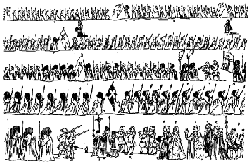 All those who had "made the mission" (that is, had taken part in it and made their confession) took part in this procession, carrying in their hands a Rosary, a Cross and their "Covenant Contract". This was a printed formula, distributed by the missioner, which contained the words in which the renewal of Baptismal vows was made. We possess a few different versions of this formula, including one signed by St Louis Marie himself. The formula was to be read out, and signed by the one making the renewal (or at least their mark made on it), and by the missioner. The procession was headed by the Cross and various banners, and the Blessed Sacrament was carried, as well as the Book of the Gospels, carried by a deacon. Arriving at the altar of repose (where the Blessed Sacrament was placed), the deacon read the gospel, and Fr. de Montfort preached. This seems to have taken place, often, somewhere other than the church, since, afterwards, the procession continued on its way (according to Grandet) to the main door of the parish church.
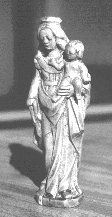 It was here that the part of the ceremony specifically relating to the renewal of Baptismal vows took place. The deacon who had carried the Book of the Gospels there sat down in a chair, with the Book of the Gospels open on his knees. Everyone who had taken part in the procession approached individually, knelt and kissed the Book of the Gospels, and said: "I firmly believe all the truths of the Holy Gospel of Jesus Christ." They then entered the church and passed before the Baptismal font, where a priest got them to pronounce their Baptismal vows, and they were invited to kiss the font, saying: "I renew with all my heart the vows of my Baptism, and I renounce for ever, the devil, the world and myself." From here they moved on to an altar, where Fr. de Montfort himself would offer them a small statue of Our Blessed Lady to kiss (perhaps often the very one that he had carved and which he carried fixed to the top of his walking staff), while they said the words: "I give myself entirely to Jesus Christ through the hands of Mary, to carry my cross after him all the days of my life." This was followed by the singing of the Creed, when everyone joined in, and then Fr. de Montfort would preach his sermon.
It is interesting to note that, towards the end of the sermon, Fr. de Montfort would ask the deacon, "What rule must all Christians follow to merit eternal happiness?" And the deacon would reply, holding high the Book of the Gospels, "This is the rule of all Christians. Anyone who does not observe all its precepts, and those of the Church, will not enter the Kingdom of Heaven." He then carried the Book to the preacher, who received it on his knees before continuing his sermon. It is clear from this that for Montfort, what he was preaching was soundly based in the Gospels, which, rather than any form of devotional practice, were the only rule of life.
 In this ceremony, the culmination of his parish mission, we see the central importance Montfort gave to the renewal of Baptismal vows. But it did not end with a ceremony. This was something which would need to be put into practice day after day. And so he continually encouraged the people to make it a central part of their lives, by showing them a way of continuing it in daily life. This was his "perfect devotion" to Mary. He claimed, relying on his own experience and the teaching of so many others in the Church, that "total consecration to Jesus Christ through the hands of Mary" (the essence of this "perfect devotion") was, in effect, nothing else but a "perfect" renewal of Baptismal promises: "this devotion could rightly be called a perfect renewal of the vows and promises of holy baptism" (cf. TD 120, 126). It is so, because it involves the same renunciation of "the devil, the world and oneself", and the same total dedication of oneself to following Jesus Christ, with the added advantage that it invokes explicitly the powerful intercession and example of the Blessed Virgin Mary. And it is "perfect" because (among other things) it gives the opportunity for daily renewal of this Baptismal commitment.
Once again it is clear that St. Louis Marie’s well-known devotion to our Blessed Lady is not the end of his teaching, but a means to bring people to a renewal of Baptism. It is Baptism into Christ which is the way to salvation, and baptismal life which will guarantee it. But "perfect devotion" to Mary will make that faithfulness to Baptism so much more effective.
Paul R. Allerton, S.M.M.
