
In the Footsteps of St. Louis Marie de Montfort

"Footsteps Online"
Winter 2005 (Volume 9, Issue 3)
A Visit to Africa
Father Paul Allerton, the editor of "Footsteps", recently visited Africa to give retreats to our confreres there, and to help our students there in their understanding of Montfortian Spirituality. Here he shares with us some of his impressions.
I had the great good fortune this year to be invited to give retreats to our African confreres, and a week of Montfortian Spirituality to our scholastics there. Our "African Delegation" (as it is called) was set up officially on May 1st 2001, in response to the increasing number of African members of the Congregation, and the decreasing availability of "foreign" missionaries. Previously, there had been a number of "Provincial Delegations" or Missionary Regions, administered (and largely staffed) by one or other of our major Provinces. So, for example, the British and Irish Province had for a number of years a "delegation" in Malawi, where three other Provinces were also involved: the French, Dutch and Italian Provinces, each with their own "delegation". Similarly, the Belgian Province had a delegation in the Democratic Republic of Congo, while there were small groups of missionaries in Uganda and Zambia.
Until relatively recently, it was the policy of nearly all religious congregations with missionaries in African countries, to refrain from recruiting candidates among the Africans for themselves. Rather, all the missionary efforts were directed towards building up the local churches, including the formation of a native diocesan clergy. However, as the number of African priests grew, it was seen as more and more desirable that the Religious Life should also be established among the Africans themselves, and so most Congregations began recruiting African members. The Company of Mary was no exception, and eventually it became necessary to establish training programmes for these candidates in Africa itself. Since there were candidates coming from various countries (Malawi, Congo, Uganda and Madagascar - the large island off the East African coast), the first thought was to establish a bi-lingual formation programme (English and French). This, however, proved quite difficult, so it was decided that all the formation on the African mainland would be provided in English, while the candidates from Madagascar would follow their own programmes in Madagascar itself.
A Novitiate was established in Uganda (Mbarara), and a Scholasticate (senior seminary) in Nairobi, Kenya. Pre-novitiate training and assessment was to be done in the various countries involved. After only a few years, there were enough young men entering the Congregation from the various African countries, that the decision was taken to establish the "African Delegation". All the former Provincial missionary delegations were dissolved, (with the exception - for the time being - of the Italian Delegation in Malawi), their members, for the most part, being seconded to the new African Delegation. At present the members of the delegation number about 30, of whom 23 or 24 are of African descent - from Malawi, the Congo, Uganda, Kenya and Zambia.
Malawi
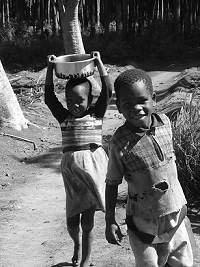 In July, after flying on 29 June to Nairobi, and from there on 1 July to Malawi, I gave a retreat to a group of about 10 at the Montfort Pastoral Centre in Nantipwili, not far from Blantyre, the commercial capital of Malawi. I was surprised to find that the temperature there was actually somewhat lower than what I had left behind in Scotland, and overcast most of the time, to boot! It has to be remembered of course that Blantyre (and Nantipwili) is in the Southern Highlands of Malawi (about 3,000 ft above sea-level). Despite the cloud cover, that part of Malawi has had no decent rains for a couple of years, and the people of Malawi are in danger of famine, along with so many others in sub-Saharan Africa. This fact, added to the universal prevalence of AIDS-HIV, and the general poverty of the country (Malawi is reckoned to be the 6th poorest country in the world), would, you would think, make the population miserable - but one of the most striking things about the Malawian people (and other African peoples) is their cheerfulness in the face of so much hardship. Not for nothing is Malawi called "the warm heart of Africa"! The smiling faces of the two children in my photograph bear witness to this.
After the retreat at Nantipwili, I had the opportunity to spend a few days at "Montfort Cottage" - a modest holiday cottage on the shores of Lake Malawi - and I thought I was in Paradise! This has to be one of the most beautiful places on earth, and there the weather lived up to what we imagine Africa to be like - warmth and brilliant sunshine all day long.
Then I went to spend a few days at Namitembo Mission in the Shire Valley, where the two remaining members of the British and Irish Province in Malawi work: Fr. Owen O'Donnell and Fr. Frank Loughran, who work alongside a Malawian diocesan priest, Fr. Philip. Fr. Frank is now 90 years old, but still takes a full part in the work of the mission. He has been in Malawi now for 62 years, and has no intention of dying anywhere else!
Namitembo is fairly typical of the missions cared for by the Company of Mary in Malawi. It has several "out-churches", where there are "small Christian communities" established, which take responsibility for the daily Christian lives of the Catholic people. The missionaries themselves go to one or other of these out-churches at the weekend to celebrate Mass and administer the sacraments, but the upkeep of the church buildings and the schools, and the daily prayer-lives of the people are largely in the hands of the local community. 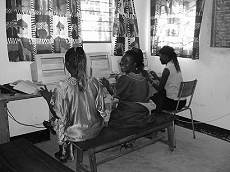 At the mission itself, there are also various projects established to aid the people. In Namitembo, for example, there is a maize-mill to which the people from all around come to grind their maize into the flour from which they make their staple food, nsima. There is also a trade school, where the young people can be trained in various trades, and have the opportunity to learn word-processing, for example, on the computer. This trade school is largely funded by help from a parish in Seattle, USA. Namitembo has both a primary school (with more than 1,200 pupils), and a secondary school (with perhaps 250 pupils). While primary schooling is more and more available for most children in Malawi, secondary education is still only available for relatively few.
Almost all Europeans who visit Africa are impressed by the singing of the African people, and I was no exception. The Sunday liturgy in Namitembo was a delight, even though, because of all the singing and dancing (very graceful liturgical dancing), it lasted for 2¼ hours! Clearly everyone was involved in this joyful celebration, and afterwards they lingered outside in their "Sunday best", talking with their friends and acquaintances - it seemed to be quite difficult to get them to go home! If only we had the same problem in our own country!
Uganda
From Malawi, I flew back to Nairobi with Fr. Blaise Jailosi, the Malawian superior of the African Delegation, to stay one night before going on to Uganda (there are no direct flights between Malawi and Uganda). After landing in Entebbe (the airport for the capital of Uganda, Kampala), we were met by Fr. Charlie Beirne, who had just returned from his leave in England, and he drove us the 250 km or so down to Mbarara in the South-West, where the Delegation has its novitiate. On the way we crossed the equator from North to South; but again I was surprised at how relatively cool it was, even on the equator.
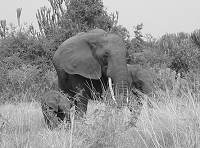 Before we began the second retreat in Mbarara (attended by the members of that community, as well as 5 or 6 of our confreres from the Congo, who had come by bus through Rwanda!), I had an opportunity to go to the Queen Elizabeth National Park to see the elephants and other wildlife there, including wild boar and antelopes of various kinds. It is quite an experience to see a wild elephant at relatively close quarters - but you don't get out of your vehicle if you value your life!
In many ways, Uganda is quite different from Malawi. For one thing, the staple diet there is largely bananas - not the kind we eat as fruit, but what we would probably call plantain, which needs to be cooked before it can be eaten. The people in Uganda seem to have adopted European dress more readily than those of Malawi, and the land seemed to me to be greener; though perhaps that part of Uganda has not been so affected by the drought that has afflicted much of Africa in recent years. But the local people seemed to me to be just as warm and cheerful and welcoming - and again their liturgies were enlivened by much singing and dancing. At the end of this retreat, we celebrated the baptism of a little girl, who, along with her 2- and 3-year old companions, was completely absorbed in the dancing - they learn to dance very young all over Africa.
Mbarara is the place where Fr. Charlie Beirne runs his campaign, with the help of so many of our Associates, to provide schooling for poor children, often AIDS orphans. And such help is desperately needed - it seemed to me that, though perhaps a little more affluent (if one can use that word in Africa) than Malawi, Uganda is also a very poor country by our standards, and education is clearly the key to a better life for most of the people.
Kenya
After the retreat in Mbarara, it was back to Nairobi in Kenya, where I was due to give a week of Montfortian Spirituality to the Montfortian students in the scholasticate, followed by their annual retreat. But first, I was taken to the Nairobi National Park, where I was able to see more of the typical African wildlife, including giraffes and zebra; though we were not lucky enough to come across any lions or other big cats.
Another experience I enjoyed was attending Sunday Mass at the Salesian Shrine of Mary Help of Christians in Nairobi. Once again the participation of the people in the singing and the rest of the liturgy was remarkable, and the sense of joy in the celebration was palpable. We had to get to the church pretty early to be sure of a place!
Nairobi itself is much like any other big city around the world, with its towering office blocks and busy shops. But the economic difficulties experienced by most African countries were evident in the poor state of the roads and pavements. However, the signs of poverty in Nairobi were nothing compared to what I was able to observe when we went out (at the end of the students' retreat) to Thika, the scene of Elspeth Huxley's "The Flame Trees of Thika". We had gone to see the Fourteen Falls, a spectacular waterfall rivalling in width (though not in height) the Niagara Falls; but what struck me more than anything was the sight of so many poorly-housed and poorly-clad people in those areas away from the capital. And Kenya is one of the more developed countries of Africa!
Once again, the weather in Nairobi was distinctly unlike what I had expected of Africa - I had to wear a sweater most days, and we had several days of drizzly rain. Again, though, Nairobi is in the highlands (in fact, it is 5,450 ft above sea-level), so that, even though it is only just south of the equator, its climate is relatively cool. It was the only place, apart from Namitembo in Malawi, where I was bitten by mosquitoes!
A new phenomenon that I observed since my last visit to Africa in 1993 was the ubiquity of the mobile phone! It seems to be as popular among the better-off people of the towns and cities as it is here in Gt. Britain. But in Malawi in particular, it has been a great boon. Telephone landlines in that country are rare - apparently it was common for the telegraph poles and wires to be stolen - the poles for firewood, and the wires for other purposes. The coming of the mobile phone has truly revolutionised communications in Malawi, to the great benefit of the remoter mission stations among others. The two missions that the African Delegation of the Company of Mary cares for (Sitima and Namitembo) have never had a telephone before - now they can be in regular contact both with each other and with the rest of the delegation.
I am truly grateful to Fr. Blaise Jailosi and the members of our African Delegation for giving me the opportunity to visit them, and see something more of our mission in Africa. I hope that I was able to give them something worthwhile in return. Please continue to pray for the growth of our Congregation there.
