
In the Footsteps of St. Louis Marie de Montfort

"Footsteps Online"
Winter 2005 (Volume 9, Issue 3)
The Cross in the Teaching of St. Louis Marie de Montfort
September 14th was the Feast of the Exaltation of the Cross, a feast which originally is said to have commemorated the finding of the relics of the Cross of Christ in Jerusalem by St. Helen, the mother of the Emperor Constantine, and their solemn veneration as the instrument of our salvation. Today it is one of those special occasions when we recall the great love shown to us by Jesus, when he chose to die on the Cross to save us. 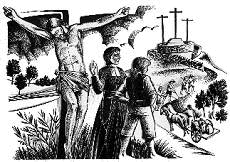 It had a special significance for St. Louis Marie de Montfort in 1710, for it was that day that he had chosen for the blessing of the immense Calvary he had caused to be built, with the help of thousands of people, on the Magdalene Heath outside Pontchâteau. But it was to be a day of the Cross in another way for him, for the blessing of the Calvary was forbidden by order of the Royal Court, and a few days later the order was given for it to be demolished. This was a tremendous disappointment for St. Louis Marie, but he accepted it, as always when he had to suffer setbacks, as a share in the Cross of Jesus himself.
In St. Louis Marie's writings there is a very close link between Wisdom and the Cross - as he says in his famous dictum: "Wisdom is the Cross, and the Cross is Wisdom" (The Love of Eternal Wisdom [LEW], no. 180). In this article I would like to examine what he has to say on this great theme of his personal spirituality, the spirituality that he passed on to us and others in his missions and his writings.
Whenever Montfort spoke of the cross, it was always in reference to the Cross of Jesus Christ himself, or the sharing in the sufferings of Christ which are the lot of every Christian. And just as he assures us that the suffering of Jesus was something that "he chose to endure to prove his love for us" (LEW 154), so he saw all the suffering he himself had to endure, and indeed all the suffering any Christian meets with in his or her life, in terms of love rather than merely in terms of self-discipline or asceticism (although he would not deny their value from these points of view either). He himself suffered the Cross, above all, for love of God, and he recommends to all that they view the cross in the same terms: "Let us show our love for Jesus in the best way, that is, through all kinds of crosses" (Letter to the Friends of the Cross [LFC], no. 12).
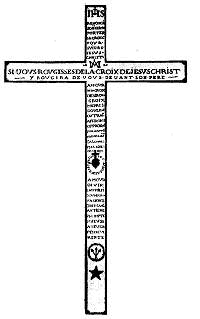
St. Louis Marie's teaching on the Cross is found in systematic form principally in three works: The Love of Eternal Wisdom, the Letter to the Friends of the Cross (LFC), and the Wisdom Cross of Poitiers (WCP). In addition to these, some of his hymns (notably no. 19 and no. 102, both of which are on "The Triumph of the Cross") echo the teaching especially of chapters 13 and 14 of LEW. His Letters, particularly nos. 14-17, 20, 32-34, also contain reflections of his teaching in LEW and LFC, with a bearing in particular on the link between Wisdom and the Cross. There are other less prominent references throughout his writings, notably True Devotion to the Blessed Virgin, and The Secret of Mary. From all this, it is evident that the theme of the Cross is interwoven throughout his teaching, and indeed has to be seen as a major theme of his spirituality.
St. Louis Marie's understanding of the Cross flows from his understanding, in the light of the Old and New Testaments, of God's plan of love, life and salvation for humanity. To realize this plan, God chose to become flesh ("incarnate") to redeem the world (LEW 42-46; 70). And, in order to achieve this redemption, the Incarnate Word of God, Jesus Christ, chose to suffer and to die in place of man, enduring all the sufferings involved in this "to prove his love for us" (LEW 70; 154, and chapter 13 in general). The manner of his redemptive death was crucifixion - death on a cross - a particularly barbarous form of execution usually reserved for the worst criminals by the Roman authorities of the day. The cross therefore becomes, because of the love with which his death on it was accepted and endured by Jesus, "the greatest secret of the King - the greatest mystery of Eternal Wisdom" (LEW 167). It is a mystery in several senses: it might be expected "that this Wisdom incarnate would appear glorious and triumphant… [and would] crush all his enemies and win the hearts of men by his attractiveness, his delights, his magnificence and his riches… But O wonder!… He sees… a cross… [and] he decides that that will be the instrument of his conquests…" (LEW 168. Cf. Heb 12.2). But it is a mystery also in the sense given to the word by what is known as "The French School of Spirituality" (of which St. Louis Marie is generally considered to be a part), namely that, though it has an historical and unrepeatable aspect, it is an expression of the interior dispositions and sentiments of Jesus which endure and with which the Christian can enter into communion (cf. LEW 169-172). This is the basis of St. Louis Marie's teaching on "The Cross and ourselves", which forms the substance of the Letter to the Friends of the Cross, as well as LEW, chapter 14.2-3 (nos. 173-180) and what he writes on "mortification" in LEW chapter 16 (194-202). Through communion with the mystery of Christ's Cross, it becomes "the sign, the emblem and the weapon of his faithful people" (LEW 173).
 It is clear that for Montfort, as for all Christian writers, the "cross" in the life of Jesus does not refer only to the means of his execution, the particular form of death he was to endure, nor indeed solely to his death and the suffering involved in that; but refers to all the suffering he would endure ("to prove his love for us") throughout his life as a direct consequence of becoming a human being, thus joining the Word and sinful flesh. But the most obvious instance of his suffering, and the clearest manifestation of the love that inspires its endurance, is the Passion and Death of Jesus, which Montfort meditates on in LEW 155-166. And he portrays Christ as directing his thoughts and desires to that culminating sacrifice throughout his life, seeking, and indeed "longing for" the cross (LEW 170). In this he shows the clear influence of Henri Boudon's book Les saintes voies de la Croix (The Holy Ways of the Cross), which, according to his friend Jean-Baptiste Blain, was his favourite book in his seminary days. This "longing for the cross" is foolishness to those who "do not understand the mysterious language of the Cross" (LEW 178), but to those who have understood the love which inspires it, it becomes "the wisdom of God" (1 Cor 1.24). Hence, the Cross is a mystery of love and of Wisdom, quite opposed to the false wisdoms of the world and of the flesh (cf. LEW 75-83). The link between Eternal Wisdom (Jesus Christ) and the Cross is indissoluble: "Never the Cross without Jesus, or Jesus without the Cross" (LEW 172); indeed, "Wisdom is the Cross, and the Cross is Wisdom" (LEW 180).
Montfort's understanding of the Cross of Christ himself, shapes his teaching on the Cross in relation to ourselves. Just as the Cross is inseparable from the life of Jesus, so it is an inseparable part of the life of Christians: "Eternal Wisdom has decreed the Cross to be the sign, the emblem and the weapon of his faithful people. He welcomes no child that does not bear its sign. He recognises no disciple who is ashamed to display it, or who has not the courage to accept it, or who either drags it reluctantly or rejects it outright. He proclaims, 'If anyone wishes to come after me, let him renounce himself and take up his cross and follow me.' (Mt 16.24; Lk 9.23) He enlists no soldier who does not take up the cross as the weapon to defend himself against all his enemies" (LEW 173). As he writes on the Wisdom Cross of Poitiers, "If you are ashamed of the Cross of Jesus Christ, he will be ashamed of you before his Father." And, just as the Cross of Christ himself can only be ultimately explained in terms of love, so the Cross in our lives has to be inspired by love: "When it is well carried it is the source, the food and the proof of love" (LEW 176).
But what form does the Cross take in our lives? We can recognize this Cross very clearly in Montfort's own life. He suffered all his life: from inactivity in the first few months he spent in the community of Saint-Clément in Nantes, shortly after his ordination; from uncertainty regarding his true path for the first five years of his priestly life; from rejection by those institutions and people who might have been expected to value him and his friendship (the Hôpital Général of Poitiers, the Salpêtrière, his spiritual directors, even his friend Blain); from homelessness or poor lodging (e.g. in the Rue du Pot de Fer); from misunderstanding of, or outright opposition to, his preaching; from disparagement of his character and slanderous reports put about concerning him; from interdict by bishops, despite his unequivocal obedience to them; and so on - perhaps most of all from the crushing disappointment of the prohibition of the Calvary at Pontchâteau. And perhaps in all this he suffered all the more as it caused those whom he loved to suffer with him - his letter to his sister Guyonne-Jeanne, written in 1713, shows his awareness of this: "I never seem to go anywhere without bringing something of the Cross to my dearest friends without any fault of mine or theirs. Those who befriend me or support me suffer for doing so, and sometimes draw down upon themselves the wrath of the devil I am fighting against, as well as the world I am protesting against and the flesh I am chastising" (Letter 26). These sufferings, which could be seen as the inevitable consequences of his radical commitment to the Gospel and the service of Christ, he bears not just with resignation and patience, but with a joy which is foolishness to the worldly-wise "who do not know the value of the Cross and carry it reluctantly" (LEW 179), and with love, seeing in them his path to the acquisition of true Wisdom - he expresses this conviction in his Letters 15 & 16, especially.  And he counsels us to accept and endure the difficulties encountered in our own lives in the same spirit. This is the burden of the first 13 of the 14 "rules to be followed" to help us to suffer in "the way that Jesus did", in LFC 41-60. We must even try to love the cross, he tells us, not with an "emotional love", which is "impossible to our human nature", but with a "rational love, [which] springs from the knowledge of how happy we can be in suffering for God," or with a "supernatural love", by which "we love the cross we are carrying, by the light of pure faith, and take delight in it, even though the lower part of our nature may be in a state of conflict and disturbance, groaning and complaining, weeping and longing for relief" (LFC 50-53). He makes it clear that he is referring to difficulties or trials of all kinds, whether natural or the result of our own or other people's actions: "make the resolution to suffer any kind of cross without excluding or choosing any: any poverty, injustice, loss, illness, humiliation, contradiction, slander, spiritual dryness, desolation, interior and exterior trials" (LEW 54). And the motive for this acceptance of the cross is, far from merely the inevitability of all this, the following of Jesus Christ: "To suffer is not enough; the evil one and the world have their martyrs. We must suffer and carry our cross in the footsteps of Christ: 'Let him follow me'" [Lk 9.24] (LFC 41). To put this into practice requires the gift of wisdom, for "the Cross remains an object of scandal, folly, contempt and fear", which "even today is a source of scandal and an object of folly not only to Jews and pagans, Moslems and heretics, the worldly-wise and bad Catholics, but even to seemingly devout and very devout people" (LEW 174). It is a mystery which "you must learn to practise in the school of Christ, and which can only be learnt from him" (LFC 26). It is something that we need to pray for: "You may, and should, pray for the wisdom of the cross, that knowledge of the truth which we experience within ourselves and which by the light of faith deepens our knowledge of the most hidden mysteries, including that of the cross" (LFC 45).
Besides the trials and difficulties inherent in human life and in the following of Christ as true disciples, Louis Marie speaks of "mortification", which is closely allied to the Cross, and which he lists as one of the principal means for acquiring divine Wisdom. "Mortification" means (literally) "putting to death", and is used in Christian thinking to describe the practices of self-denial which are called for by Jesus when he says, "If anyone wants to be a follower of mine, let him renounce himself, and take up his cross, and follow me" (Mt 16.24). It is not a popular idea today, even among Christians, but has always been held to be important, and is certainly so for St. Louis Marie. In his thinking on this, there are clearly certain things that he sees as indispensable - without them, we cannot lay claim to wisdom ("If we would possess wisdom" is how he introduces them), or even to being a true follower of Christ. These imperatives, listed in LEW, include: detachment from what he calls "worldly possessions", if not actually dispossessing ourselves of these; not subscribing to worldly fashions, habits and ways of living; not subscribing to the false "wisdom" of the world or its maxims (e.g. the world tells us today that you have to "have fun"); and avoiding the company of worldly folk, or even of others if it is just a waste of time. It is true that some of these imperatives flow from his own cultural background, as well as from the very radical view he took of the Gospel, but at the same time, he bases them, at least loosely, on the Scriptures (1 Cor 7.30, Rom 12.2, and 1 Jn 5.19, for example), or on the received wisdom of Christian spiritual writers (LEW 197-200). However, we might need to reinterpret these (which is not the same as abandoning them) for today's circumstances.
Then there is the question of voluntary penances or acts of mortification - which we willingly take on without any real obligation. He imposed on himself, as we know from his biographies, some very severe (to today's eyes) penitential practices (the discipline, hair-shirts, spiked bracelets and girdles, etc.), and he also seems to have encouraged others to do the same, even selling such instruments of penance during his missions. His teaching regarding voluntary penances is clear: "If we would possess Wisdom, we must mortify the body, not only by enduring patiently our bodily ailments, the inconveniences of the weather and the difficulties arising from other people's actions, but also by deliberately undertaking some penances and mortifications, such as fasts, vigils and other austerities practised by holy penitents" (LEW 201). However, he prescribes that these penances, if they are not quite simple things, should not be undertaken without guidance from a spiritual director or confessor: "For exterior and voluntary mortification to be profitable, it must be accompanied by the mortifying of the judgement and the will through holy obedience, because without this obedience all mortification is spoiled by self-will and often becomes more pleasing to the devil than to God. That is why no exceptional mortification should be undertaken without seeking counsel" (LEW 202). And again, his rule number 14 in LFC, to help us to suffer as Jesus did, says: "If you want to make yourself worthy of the best kind of crosses, that is, those which come to you without your choosing, then under the guidance of a prudent director, take up some of your own accord" (LFC 61).
The kinds of voluntary mortification or penance that we might take up are listed somewhat differently in LEW and LFC. LEW prescribes "fasts, vigils and other austerities practised by holy penitents", while LFC gives other examples: giving away a piece of furniture we are fond of; eating some food we don't really like, or in other ways acting in opposition to our own likes and dislikes; seeing less of a person we may perhaps be too fond of, or limiting our enjoyment of things we particularly like; curbing our natural curiosity and our tongues; and even deliberately courting the company of people we don't naturally like, etc. (LFC 61). In all of this, there is certainly an element of exercising self-discipline (as he says in one instance, "thus conquer yourself"), and this is in keeping with not only Christian spirituality, but also that of all the great world religions; but for Montfort this is not the main motive - he begins this number with: "If you want to make yourself worthy of the best kind of crosses, those which come to you without your choosing…" - and these are the things that he has said are to be done for the sake of "following Christ". Then, at the end of this list of suggestions, he returns to his main motive: "If you are truly Friends of the Cross, then, without your knowing it, love, which is ever ingenious, will discover thousands of little crosses to enrich you…" - it is love which again is the motive (LFC 62). Let it be so for us - let us try to show our love for Jesus in the same way.
